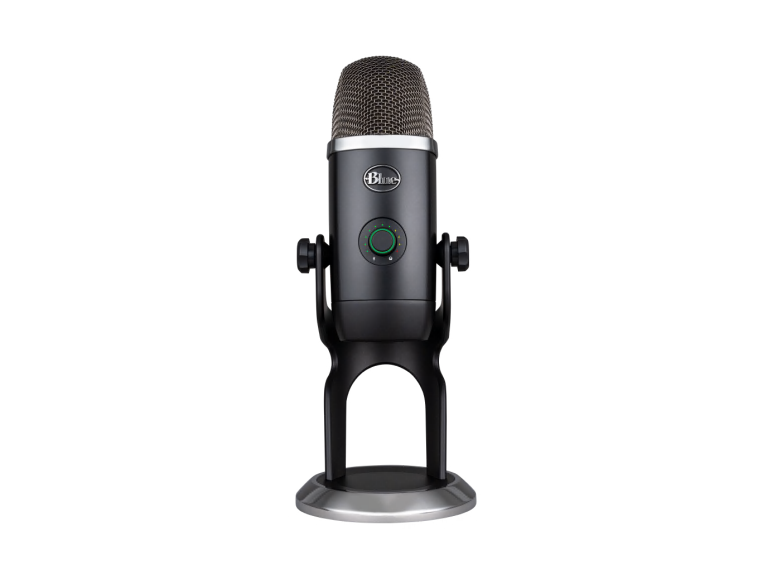
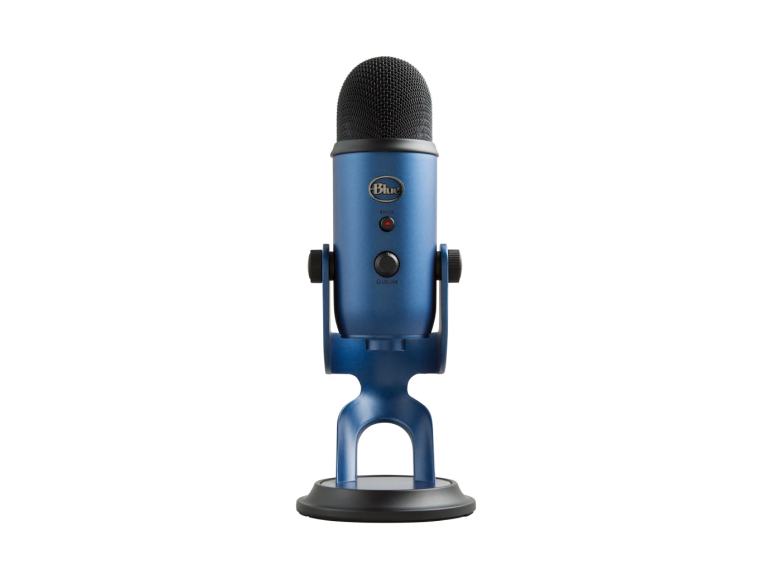
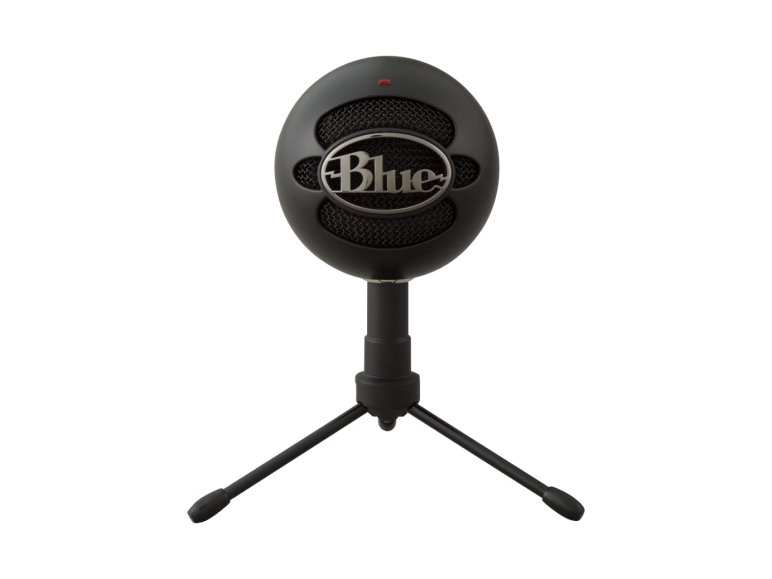
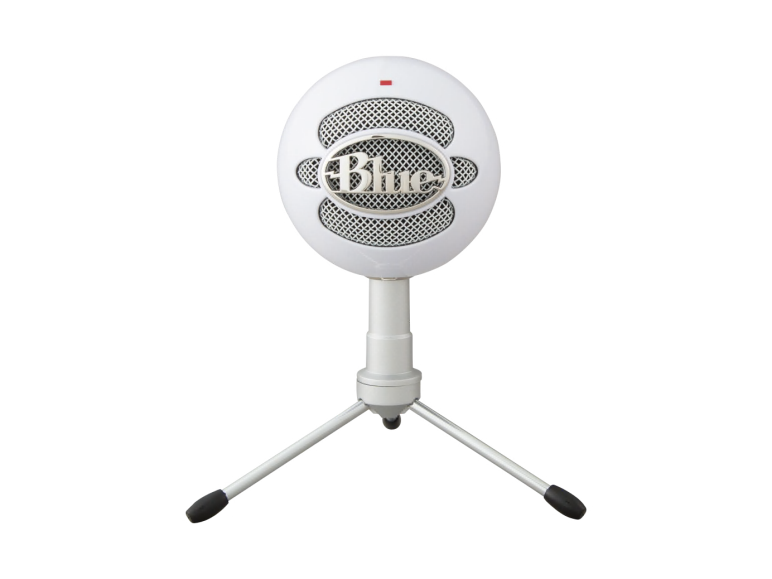
Favorite Blue Mic: en·CORE 200

Home Town: Brooklyn, NY

Current Album: Temporary People

Release Date: October 28, 2008

Produced By:
Kenny Siegal and Joseph Arthur & the Lonely Astronauts

Record Label: Lonely Astronaut

Image Gallery


Video Gallery


My Mic


About

For his entire, decade-long recording career, Joseph Arthur has been a gushing fountain of creativity, and he doesn’t show any signs of slowing down. While he’s now releasing four EPs as a prelude to the full-length album All You Need Is Nothing, he’s actually done this once before, releasing his four Junkyard Hearts EPs to prepare the way for his well- received 2002 full-length Redemption’s Son. Arthur is a prolific visual artist as well, with the paintings that decorated his 2000 Vacancy EP earning him a Grammy nomination for package design.

“I don’t really believe in ‘writer’s block,’” the artist notes, chuckling and doodling as he talks. ”Because I’m always looking for a way to get what I’ve recorded and written released. I have ‘releasing block.’”

Arthur is both lyrically inventive and musically restless. His two previous full lengths, released just nine months apart—Let’s Just Be and Nuclear Daydream— showcased two different sides of his musical leanings—raw, Stones-y swagger on the former, and meticulously produced atmospheric pop on the latter. And now, thanks his independent label, Lonely Astronaut Records, Arthur has something of a cure for ‘releasing block,’ with much more freedom to offer his limitless creativity to the world.

Joseph Arthur was born and raised in Akron, Ohio, and in the individualism of his approach, he’s often been compared to the idiosyncratic artists who hail from the same region—from Devo to Pere Ubu to the Pretenders. “The Midwest is a good place for imagination,” Arthur notes. “It’s a great place to be from if you’re an artist. And unlike growing up somewhere like New York, you don’t see as much of the artist’s life. It’s a magical mystery to you.”

Arthur’s musical life started off like many others, with mandatory piano lessons. But once he realized he could use the piano to conjure up his own musical worlds, he took to the instrument and began writing songs, eventually playing in bands while in high school.

Upon graduation he moved to Atlanta with a band, playing bass and supporting himself with day jobs—from a music store to a hipster jewelry/tattoo shop. Interestingly, Cat Power’s Chan Marshall was on the scene at the same time, serving up pizza just across the street from a store where Arthur worked, and urban performance artist Benjamin was turning heads in his shambolic ensemble Smoke. “There was just a lot of creativity going on there,” Arthur recalls. “It seemed like a magical place, a magical time.”

Ironically, with so much creative energy around him, Arthur was putting less emphasis on songwriting at the time, instead taking dead aim at becoming a world-class “fusion jazz” bass player and modeling himself after Weather Report’s Jaco Pastorius.

“That was my dude, right there!” Arthur recalls, laughing.

However, when a demo tape of Arthur’s songs somehow made its way to Peter Gabriel and Real World Records, “I came to find out that Peter thought the bass playing was weak on my stuff, but what he liked was the lyrics.”

Next thing Arthur knew, he was playing at Gabriel’s WOMAD (despite having played solo acoustic “maybe one time before”), jamming with Gabriel and Joe Strummer in Real World studios in Bath, England, and was subsequently signed to Real World Records. “It was crazy,” Arthur says. “I think I like repeating the story more the older I get.”

Arthur’s debut, Big City Secrets, was a smashing success in France, putting Arthur in front of large enthusiastic crowds who’d embraced the record. “I was like, wow, this is easy,” he recalls. “I’m getting ready to go do this in America now. ‘Look out, my star is rising!’”

However, Big City Secrets made barely a stateside ripple, with the artist not really connecting with an audience until his second full-length, Come To Where I’m From, an album that features one of Arthur’s signature songs, “In The Sun.” “In The Sun,” with its emotionally vulnerable lyrics, touching on open-ended spirituality, has had an active second life, with a 2006 iTunes single featuring six covers of the song (from R.E.M.’s Michael Stipe and Coldplay’s Chris Martin, with remixes by Justin Timberlake and will.i.am) to benefit Hurricane Katrina relief.

The effort opened doors for Arthur to participate in more humanitarian work, with the artist visiting Uganda to teach painting and offer his music to war refugees there. “I think most people who are asked to be a part of something like that would love to,” Arthur notes. “I don’t think it’s any great achievement on my part; I just got lucky enough to get asked to be a part of something.”

Arthur’s spirituality is an oft-discussed part of his writing, with words like “God” and “Jesus” popping up in his songs. While Arthur disdains religion, he’s definitely a seeker. Interestingly, his lyrical discussion of the Big Questions actually stems from punk rock- inspired rebellion, he says.

“I think spirituality is a subversive thing to talk about today,” he notes. “I think it’s more subversive to talk about death than it is to say, ‘I wanna be an anarchist.’ That doesn’t strike me as subversive anymore.”

And as Arthur writes, he often records just as quickly, lately playing “mad scientist” and recording every note—both instrumental and vocal—at his Brooklyn gallery which doubles as a studio, the Museum of Modern Arthur. And though he’s made big-budget records in England and Los Angeles, he notes that in one key aspect, the process is the same.

“At the end of the day, you come back to a place where you’re making the choice about what’s going to be on that record. You’re remixing things and changing things at the last minute. So it comes back down to that too. Even if it’s a group process, if your name’s on it, it comes back down to you.”

Ten years into his career, with a growing cult of fans and famous admirers, Arthur’s muse remains restless. “I’m digging for oil and I haven’t hit a gusher yet,” he observes. So he’ll keep writing, playing, painting and recording as long as inspiration remains.

“I feel in some ways like I’m still just beginning,” he says, laughing as he observes, “it takes a long time to recover from wanting to be a fusion bass player!”